
Public Address System Services in India: Features, Applications & Installation Process

In India’s busy malls, sprawling factories, crowded railway stations and high-rise offices, clear communication is a safety requirement. A well-designed Public Address System lets one operator reach thousands of people at once, whether for a routine announcement or an emergency evacuation. MRD Infratech designs, installs and maintains Extra Low Voltage (ELV) and life safety systems for industrial, commercial and residential sites, and public address solutions are a core part of that work. This guide covers how these systems work, what features to look for, where they are used, and how a professional installation is carried out.
What Is a Public Address System and How Does It Work?
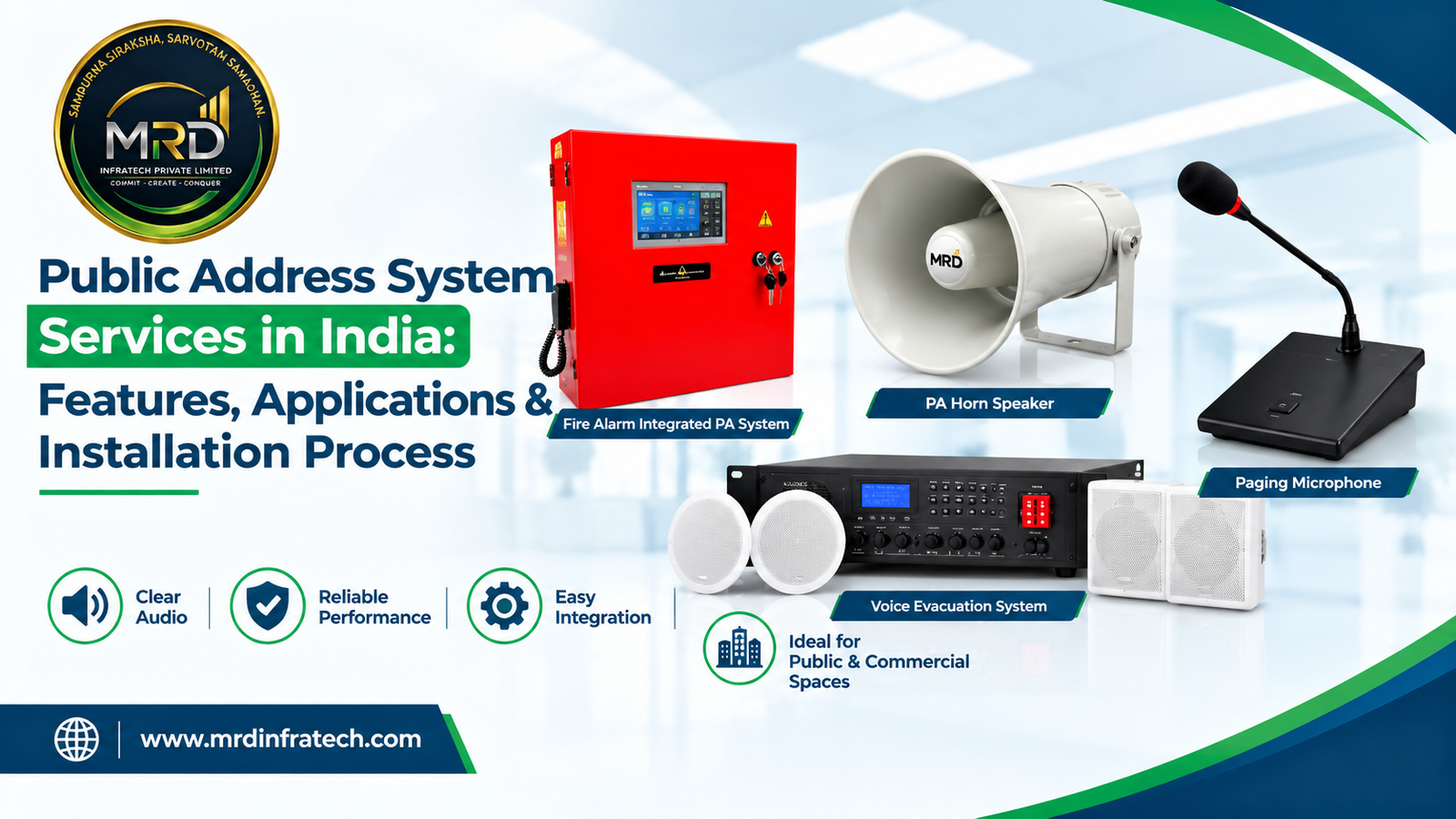
A Public Address System, commonly called a PA system, is an electronic setup that captures sound from a microphone or audio source, amplifies it and delivers it through loudspeakers placed across a building or campus. Every system is built from the same basic components: a paging microphone, a controller or mixer, power amplifiers, speakers and the cabling that connects them.
Most professional installations use constant voltage (70V or 100V) speaker lines. This lets many speakers run on a single line over long distances without losing sound quality, which is why the approach suits large facilities such as factories, campuses and airports.
Key Features of a Modern PA System
Today’s systems do much more than broadcast a voice. When you evaluate a solution, look for these features:
- Zone selection, so you can announce to one floor, one wing or the entire premises
- Priority paging, so emergency messages override routine announcements
- Wired or network-based paging microphones for flexible control
- Pre-recorded and live voice messages
- Background music and scheduled announcements for retail and hospitality spaces
- High sound projection for noisy or outdoor areas
- Easy expansion as your building or campus grows
Reliability matters as much as features. Quality amplifiers, durable speakers and a clean cabling layout decide whether the system works when you need it most.
Why Every Public Address System Needs Voice Evacuation Capability
In a fire or other emergency, sirens alone can cause confusion. People hear an alarm but do not know where to go. A Public Address System integrated with the fire alarm panel solves this by delivering clear voice instructions, such as which exit to use or which floor to evacuate first.
A voice evacuation system activates automatically when the fire alarm triggers, and staff can also override it with live manual paging. Operators can guide different zones differently, sending people away from danger while keeping unaffected areas calm. For malls, hospitals, airports and high-rise buildings, this integration is one of the most valuable safety upgrades available.
Applications of PA Systems Across India
PA systems serve almost every sector. Here are the most common uses.
Commercial Buildings and Malls
Shopping centres and office towers use PA systems for announcements, lost-and-found alerts, promotional messages and background music. The same infrastructure doubles as an emergency communication channel.
Hospitals and Healthcare
Hospitals need calm, controlled communication. Zoned paging helps staff reach doctors and departments without disturbing patients, and voice evacuation protects vulnerable occupants during emergencies.
Factories and Industrial Plants
Machinery noise makes ordinary speech useless. Weatherproof horn speakers deliver announcements across production floors, yards and loading areas, helping with shift changes, safety alerts and emergency calls.
Schools, Colleges and Campuses
Educational institutions use paging for timetables, assemblies, notices and safety drills. Outdoor horn speakers cover playgrounds and large open areas.
Airports, Railway Stations and Public Spaces
Transport hubs depend on clear, intelligible announcements for passenger flow and crowd safety. These sites typically need advanced zoning, priority paging and integrated emergency messaging.
Hotels, Hospitality and Residential Complexes
Hotels use PA for background music and guest information, while residential societies use it for notices and security alerts.
The Installation Process: Step by Step
A professional PA installation follows a structured path from concept to commissioning. Here is how MRD Infratech approaches it.
1. Site Survey and Requirement Analysis
Engineers visit the site to study the layout, ceiling types, noise levels, occupancy and special zones. This shapes decisions about speaker types, coverage and amplifier capacity.
2. System Design and Engineering
Based on the survey, the team prepares a customised system architecture covering speaker placement, zoning, amplifier sizing, cable routing and integration with other systems. Careful design prevents dead spots, distortion and overspending.
3. Equipment Selection
The right mix of ceiling speakers, horn speakers, paging microphones, amplifiers and controllers is chosen for each environment. Indoor offices need different hardware from open industrial yards.
4. Cabling and Mounting
Cables are laid neatly and safely, following good ELV practice. Speakers are mounted on walls, ceilings or poles at the planned locations for even sound coverage.
5. Integration with Fire Alarm and Other Systems
For voice evacuation, the PA system is connected to the fire alarm control panel so alarms trigger automatic announcements. Integration with building management and other ELV systems can also be arranged where needed.
6. Testing and Commissioning
Technicians test every zone for volume, clarity and coverage, verify priority paging and run emergency scenarios. Settings are fine-tuned before handover.
7. Training and Maintenance Support
Your staff should be able to operate the system confidently. Ongoing maintenance, including periodic checks of amplifiers, speakers and cabling, keeps it dependable for years.
How to Choose the Right PA System Service Provider in India
The quality of installation matters as much as the equipment. When comparing providers, consider these points:
- Experience in ELV and life safety projects, not just audio
- Ability to integrate PA with fire alarm and other building systems
- A certified, qualified engineering team
- Tie-ups with trusted technology brands
- Clear project management from design to commissioning
- Dependable after-sales service and maintenance
A provider that understands fire safety, security and networking can deliver a Public Address System that works as part of your wider building infrastructure rather than as an isolated installation. That joined-up approach reduces cost, simplifies maintenance and improves safety.
Final Thoughts
Whether you manage a hospital, a factory, a school or a commercial complex, reliable communication protects people and keeps operations running smoothly. A properly designed Public Address System combines clear everyday announcements with life-saving emergency messaging. With careful planning, quality equipment and expert installation, it becomes one of the most dependable investments in your building’s safety.